In the high-stakes world of enterprise software, C# remains a cornerstone language due to its robust ecosystem and the sheer power of the .NET framework. However, as applications scale to handle millions of transactions, even minor inefficiencies can snowball into catastrophic performance degradations. Developing enterprise-grade software requires more than just functional code; it demands a deep understanding of how the underlying runtime manages resources.
Navigating these technical hurdles is a common rite of passage for software engineers. Whether you are optimizing a high-frequency trading platform or a massive CRM system, identifying the root cause of latency is essential. For students or professionals looking to master these concepts through practical application, seeking professional c sharp assignment help can provide the necessary foundation to bridge the gap between theoretical knowledge and industry-standard implementation.
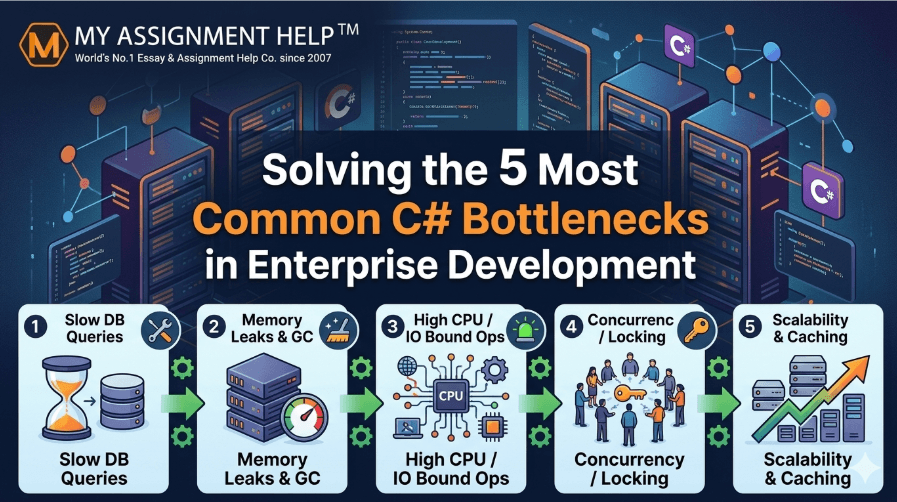
Below, we analyze the five most prevalent C# bottlenecks found in enterprise environments and provide data-driven solutions to mitigate them.
1. Excessive Garbage Collection (GC) Pressure
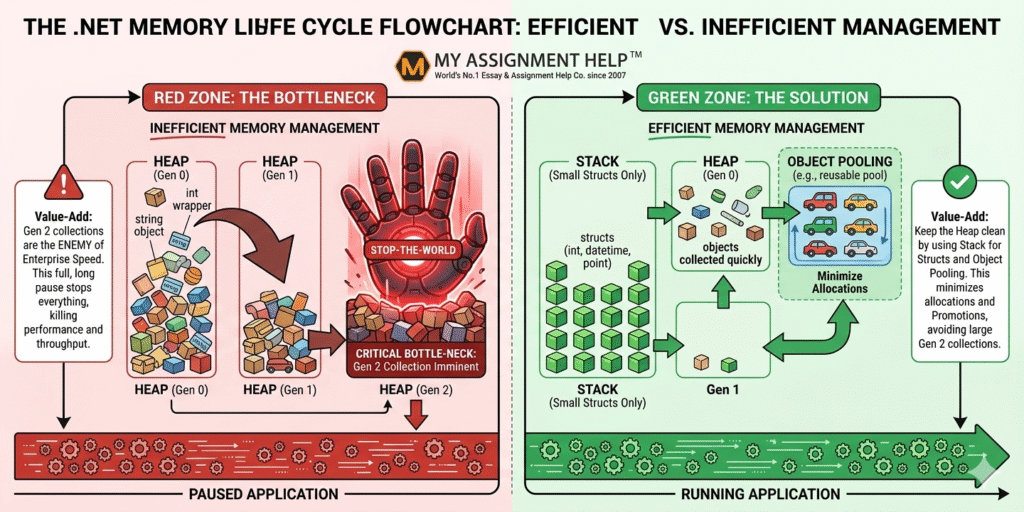
Garbage Collection is one of .NET’s greatest strengths, but it is also a frequent source of performance “stutters.” In enterprise applications, high object allocation rates—especially short-lived objects—can force the GC to run frequently, leading to “Stop-the-World” pauses.
The Bottleneck: Creating large numbers of objects on the heap leads to frequent Gen 0 and Gen 1 collections. If objects survive too long, they move to Gen 2, where collections are significantly more expensive.
The Solution:
- Use Structs for Small Data: For small, short-lived data structures, use struct (value types) instead of class (reference types) to keep data on the stack rather than the heap.
- Object Pooling: For expensive objects like database connections or large buffers, implement an ObjectPool<T> to reuse instances.
- Span and Memory: Use these modern C# features to work with contiguous memory without additional allocations.
2. Misusing LINQ (Deferred vs. Immediate Execution)
Language Integrated Query (LINQ) is elegant, but its abstraction can hide significant performance costs. Enterprise developers often fall into the trap of “Multiple Enumerations” or inefficient filtering.
The Bottleneck: LINQ queries use deferred execution. If you iterate over the same LINQ variable multiple times, the query is re-executed each time. Furthermore, performing .ToList() too early can pull thousands of unnecessary records into memory.
The Solution:
- Avoid Multiple Enumerations: If you need to access results more than once, call .ToList() or .ToArray() exactly once to persist the results.
- Filter at the Source: When using Entity Framework, ensure Where clauses are applied before the data is materialized to keep the filtering logic on the SQL server.
3. Synchronous Blocking in Async Workflows
The introduction of async/await revolutionized C# concurrency, yet “Sync-over-Async” remains a top cause of thread pool starvation in enterprise web APIs.
The Bottleneck: Calling .Result or .Wait() on an asynchronous task blocks the calling thread until the task completes. In a high-traffic environment, this quickly exhausts the Thread Pool, leading to 503 Service Unavailable errors.
The Solution:
- Async All the Way: Ensure the entire call chain is asynchronous, from the controller down to the database driver.
- ConfigureAwait(false): In library code (where UI context isn’t needed), use .ConfigureAwait(false) to reduce overhead and avoid potential deadlocks.
4. Inefficient String Concatenation
Strings in C# are immutable. Every time you “add” two strings together using the + operator in a loop, a brand-new string object is allocated in memory.
The Bottleneck: In enterprise reporting or logging modules, looping through thousands of records and concatenating strings can lead to massive memory fragmentation.
The Solution:
- StringBuilder: Use StringBuilder for complex string manipulations within loops.
- String.Create: For high-performance scenarios in .NET 6+, use String.Create to pre-allocate the exact buffer size needed.
5. Improper Database Interfacing (The N+1 Problem)
Even the most optimized C# code cannot save an application from a poorly designed database interaction layer.
The Bottleneck: The “N+1 Problem” occurs when code fetches a list of items and then performs an additional database query for each item in that list to fetch related data.
The Solution:
- Eager Loading: Use .Include() in Entity Framework to fetch related data in a single SQL JOIN.
- Dapper for Raw Speed: For microservices where every millisecond counts, consider using Dapper as a lightweight ORM to reduce the overhead of change tracking.
In complex enterprise ecosystems, C# often interacts with other languages. If your project involves a multi-tier architecture, you might also need java programming assignment help to ensure your cross-language integrations are as efficient as your backend logic.
Key Takeaways
- Prioritize Stack over Heap: Use value types and Span<T> to reduce GC overhead.
- Audit LINQ Usage: Materialize collections explicitly to avoid redundant processing.
- Commit to Async: Never block on tasks; use async/await consistently to prevent thread starvation.
- Batch Database Calls: Use eager loading to eliminate N+1 query patterns.
See also: The Role of Technology in Space Exploration
FAQ
Q: Is C# slower than C++ for enterprise apps?
A: While C++ offers manual memory management, modern .NET with JIT (Just-In-Time) compilation and hardware intrinsic support is nearly as fast, with the added benefit of faster development cycles and memory safety.
Q: When should I use StringBuilder over String.Concat?
A: Use StringBuilder when you are performing more than 3-4 concatenations inside a loop. For simple, one-off joins, string.Concat or interpolation is often optimized by the compiler.
Q: How do I identify these bottlenecks in a live environment?
A: Utilize APM (Application Performance Monitoring) tools like New Relic, Dynatrace, or the built-in .NET Profiler in Visual Studio to identify “hot paths” in your code.
Author Bio
James Miller is a Senior Technical Consultant at MyAssignmentHelp. With over 12 years of experience in full-stack enterprise development, James specializes in .NET performance tuning and distributed systems architecture. He is dedicated to helping the next generation of developers master complex coding paradigms through data-driven mentorship and technical writing.
References:
- Microsoft Learn. (2024). Performance Best Practices in .NET.
- Skeet, J. (2019). C# in Depth. Manning Publications.
- Richter, J. (2012). CLR via C#. Microsoft Press.